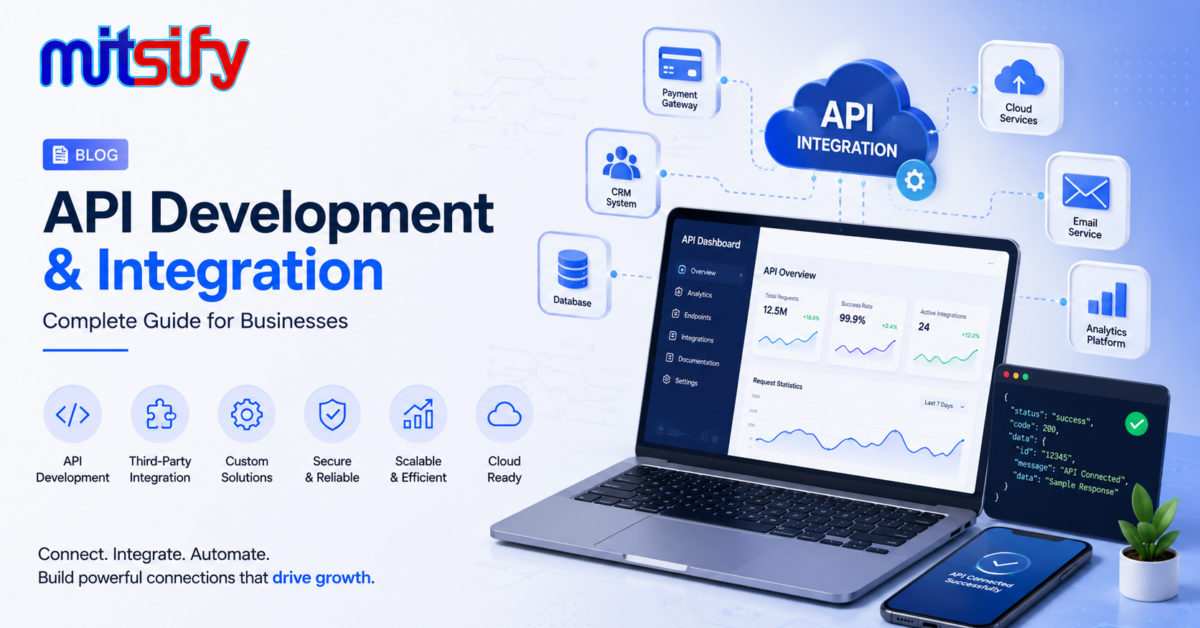
Modern businesses use multiple software applications to manage customers, sales, inventory, payments, accounting, communication, reporting, and other business operations. When these different applications need to communicate with each other, API Development & Integration becomes an important part of the technology infrastructure.
An API, or Application Programming Interface, allows different software applications to communicate and exchange data in a structured way. API integration can connect websites, mobile applications, SaaS platforms, payment gateways, CRM systems, ERP software, billing software, cloud applications, and third-party services.
In this complete guide, we will explain what API development is, what API integration means, how APIs work, different types of APIs, API development processes, security best practices, business use cases, costs, benefits, challenges, and how to choose the right API development company.
What Is API Development?
API development is the process of designing, developing, testing, securing, documenting, deploying, and maintaining an Application Programming Interface.
An API provides a controlled way for one software application to communicate with another application or service. Instead of directly accessing another application’s internal database, an application can use an API to request specific information or perform specific operations.
For example, an e-commerce application may use APIs to communicate with a payment gateway, inventory management system, shipping provider, CRM platform, and notification service.
A properly designed API acts as a bridge between different software systems while controlling what information can be accessed and what operations can be performed.
What Is API Integration?
API integration is the process of connecting two or more software applications using APIs so that they can exchange information and automate business processes.
For example, a business may connect its billing software with a payment gateway. When a customer completes a payment, the payment gateway can send the transaction result back to the billing application through an API.
API integration helps businesses reduce manual data entry, automate repetitive tasks, improve data consistency, and create connected software systems.
API Development vs API Integration
| API Development | API Integration |
|---|---|
| Building an API for a software application | Connecting existing applications using APIs |
| Focuses on API architecture and implementation | Focuses on communication between different systems |
| Includes endpoints, business logic, authentication and documentation | Includes data mapping, authentication and workflow integration |
| Can expose application functionality securely | Connects internal and third-party applications |
How Does an API Work?
APIs commonly work using a request-and-response communication model.
A client application sends a request to an API endpoint. The API receives the request, validates it, performs the required business logic, communicates with the database or another service if necessary, and returns a response.
A simple API workflow looks like this:
- The client application sends a request.
- The API receives the request.
- The API validates the request.
- Authentication and authorization checks are performed.
- The API processes the requested operation.
- The API communicates with the database or external service.
- The API sends the response back to the client.
- The client application processes and displays the information.
Simple API Example
Suppose a business application needs to retrieve customer information. It may send a request to an API endpoint such as:
GET /api/customers/1001
The API could return structured information such as:
{
    "customer_id": 1001,
    "name": "Customer Name",
    "status": "active"
}
The application can then use this information without directly accessing the database of the other system.
Types of APIs
Different API technologies and architectures can be used depending on the application’s requirements.
1. REST API
REST API is one of the most commonly used approaches for web and mobile application communication.
REST APIs commonly use HTTP methods such as GET, POST, PUT, PATCH, and DELETE to perform operations on resources.
REST APIs are widely used for SaaS applications, mobile applications, websites, e-commerce platforms, dashboards, and business software.
2. SOAP API
SOAP API is a protocol commonly used in enterprise and legacy environments where structured messaging and established standards are important.
SOAP can be found in areas such as enterprise software, financial systems, insurance applications, and legacy business systems.
3. GraphQL API
GraphQL allows clients to request the specific data they need from an API.
This can be useful when different applications or clients require different combinations of data from the same backend system.
4. Webhooks
Webhooks allow one application to automatically send information to another application when a specific event occurs.
For example, when a payment is successfully completed, a payment service can send a webhook to a business application so that the payment status can be updated automatically.
5. Internal APIs
Internal APIs are used to enable communication between services and applications within an organization.
They can help businesses build modular software systems and connect different internal applications.
Why Is API Integration Important for Businesses?
Businesses often use multiple software systems to manage their daily operations. Without integration, employees may need to manually transfer information from one system to another.
API integration allows these applications to communicate automatically.
Major benefits of API integration include:
- Automated data exchange
- Reduced manual data entry
- Improved data accuracy
- Faster business workflows
- Better customer experience
- Third-party service integration
- Improved software scalability
- Centralized system communication
- Business process automation
- Better reporting and data management
Common API Integration Use Cases
Payment Gateway Integration
Businesses can integrate payment gateways with websites, mobile applications, billing software, and e-commerce platforms.
Payment APIs can help applications initiate payments, verify transaction status, process callbacks, and update payment records.
CRM Integration
API integration can connect websites, lead-generation systems, CRM platforms, and customer management applications.
For example, a new customer enquiry submitted through a website can automatically be transferred to a CRM system using an API.
ERP Integration
Businesses can connect ERP systems with other applications to exchange information related to sales, inventory, purchasing, customers, suppliers, and accounting.
Billing Software Integration
Billing applications can integrate with payment gateways, accounting software, inventory systems, customer management platforms, and other business applications.
For jewellery businesses, API integration can also help connect billing software with other business applications.
Explore Mitsify Gold Billing Software
Pharmacy Software Integration
Pharmacy and medical-store software can integrate with payment services, accounting platforms, reporting systems, customer management applications, and other authorized business systems.
Explore Mitsify Pharmacy Billing Software
Mobile Application Integration
Mobile applications commonly use APIs to communicate with backend servers, databases, authentication systems, payment gateways, notification services, and third-party applications.
Learn More About Mobile App Development Services
API Development for SaaS Applications
APIs are an important part of many modern SaaS applications.
A SaaS platform may provide APIs for mobile applications, websites, third-party integrations, partner applications, reporting systems, payment services, and enterprise customers.
API architecture should ideally be considered during the early stages of SaaS product development rather than added only after the application is completed.
Read the Complete Guide to SaaS Development
API Development Process
A professional API development process generally includes the following stages.
1. Requirement Analysis
The first step is understanding the business requirements and defining what the API needs to accomplish.
- Which systems need to communicate?
- What data needs to be exchanged?
- Who will use the API?
- What operations should the API support?
- What security requirements exist?
- What performance requirements are expected?
2. API Architecture Design
Developers define the API architecture, endpoints, resources, request methods, response formats, authentication mechanisms, data models, and error-handling approach.
3. API Development
Developers build the API using an appropriate backend programming language and framework.
Depending on the project, technologies such as Node.js, Java, Python, .NET, PHP, or other backend technologies may be used.
4. Database Integration
Many APIs need to communicate with databases to retrieve, create, update, or delete application data.
The database architecture should be designed to support performance, security, reliability, and scalability.
5. Third-Party API Integration
The application may need to communicate with external services such as payment gateways, SMS providers, email services, CRM systems, accounting platforms, cloud services, mapping services, or other business applications.
6. Authentication and Authorization
API security should verify who is accessing the system and what operations they are allowed to perform.
Depending on the application, authentication technologies can include API keys, OAuth, JWT, or other appropriate authentication mechanisms.
7. API Testing
APIs should be tested for functionality, security, performance, reliability, validation, and error handling.
8. API Documentation
Good API documentation helps developers understand endpoints, parameters, authentication requirements, request formats, response formats, and error codes.
9. API Deployment
After development and testing, the API can be deployed to the required server or cloud infrastructure.
10. Monitoring and Maintenance
API development does not end after deployment. APIs should be monitored and maintained to identify errors, performance problems, security issues, and integration failures.
Important API Development Features
- RESTful API architecture
- Authentication and authorization
- Role-based access control
- API versioning
- Request validation
- Error handling
- Rate limiting
- Logging and monitoring
- Database integration
- Third-party API integration
- API documentation
- Secure data transmission
- Scalable architecture
- Performance optimization
API Security Best Practices
Security is one of the most important parts of API development because APIs may provide access to business data and application functionality.
Use HTTPS
HTTPS helps protect data transmitted between clients and servers by encrypting network communication.
Implement Authentication
APIs should use suitable authentication mechanisms to verify users, applications, or services accessing protected resources.
Use Authorization
Authentication determines who is accessing the API, while authorization determines what that user or application is allowed to access.
Validate API Requests
Incoming API requests should be validated before processing to reduce invalid data and potential security risks.
Use Rate Limiting
Rate limiting can help control excessive requests and protect APIs from certain types of misuse.
Monitor API Activity
Logging and monitoring can help identify failed requests, unusual activity, performance problems, and integration issues.
API Versioning
APIs may change as business requirements evolve. API versioning helps developers introduce changes while maintaining compatibility with existing applications.
For example:
/api/v1/customers
/api/v2/customers
A suitable versioning strategy should be selected based on the API consumers, application architecture, and long-term product roadmap.
API Documentation
API documentation is important when APIs are used by internal developers, external developers, customers, partners, or third-party applications.
Good API documentation should include:
- API endpoints
- HTTP methods
- Authentication requirements
- Request parameters
- Request body examples
- Response examples
- Error responses
- Status codes
- API limits
- Integration examples
API Testing
API testing verifies that an API works correctly under different conditions.
Common API testing areas include:
- Functional testing
- Integration testing
- Security testing
- Performance testing
- Load testing
- Validation testing
- Error handling testing
- Compatibility testing
Common API Integration Challenges
Different Data Formats
Two systems may use different data structures, field names, or formats. Developers may need to transform data before sending it between applications.
Authentication Issues
Different platforms may use different authentication mechanisms, which can make integrations more complex.
API Rate Limits
Some third-party APIs limit the number of requests that can be made during a specific time period.
Legacy Systems
Older business applications may not provide modern APIs. Additional integration techniques may therefore be required.
Third-Party API Changes
External service providers may change their APIs over time. Businesses need to monitor API updates and modify their integrations when necessary.
API Development Technology Stack
Backend Technologies
- Node.js
- Java
- Python
- .NET
- PHP
API Technologies
- REST
- GraphQL
- SOAP
- Webhooks
Database Technologies
- MySQL
- PostgreSQL
- MongoDB
- Microsoft SQL Server
Cloud and Infrastructure
- AWS
- Microsoft Azure
- Google Cloud
- Docker
- Cloud monitoring and logging platforms
API Integration for Web and Mobile Applications
Modern websites and mobile applications commonly use APIs as the communication layer between the frontend and backend.
A mobile application can request information from a backend API, while the backend API communicates with databases and external services.
This architecture allows businesses to build applications that support multiple platforms while keeping important business logic centralized.
API Integration for Business Automation
APIs can automate repetitive business workflows by allowing multiple applications to communicate automatically.
For example, when a customer completes a purchase, an integrated system could automatically:
- Create the sales transaction.
- Update inventory.
- Process the payment.
- Update the customer account.
- Generate an invoice.
- Send a notification.
- Update reporting information.
This type of integration can reduce repetitive manual work and improve operational efficiency.
API Development for Custom Software
Businesses may require custom software when existing applications cannot fully support their workflows.
Custom APIs can be developed as part of a broader custom software development project to connect internal applications, customer portals, mobile applications, third-party services, and business systems.
Read More About Custom Software Development
API Development for Cloud-Based Applications
Cloud-based applications often depend on APIs because different services may operate independently across cloud infrastructure.
APIs can connect cloud applications with databases, authentication services, payment platforms, analytics systems, storage services, and other applications.
Read More About Cloud-Based Software Development
How Much Does API Development Cost?
The cost of API development depends on the complexity and requirements of the project. There is no single fixed price for every API development project.
Factors that can affect the cost include:
- Number of API endpoints
- Application complexity
- Database requirements
- Third-party integrations
- Authentication requirements
- Security requirements
- API documentation
- Testing requirements
- Cloud infrastructure
- Monitoring and maintenance
- Development team expertise
A simple internal API may require less development effort than a large enterprise API platform supporting multiple applications, customers, and third-party integrations.
How to Choose an API Development Company
Selecting the right API development company is important for creating a secure, scalable, and maintainable integration.
Before choosing an API development partner, consider the following:
- Experience in API development
- Backend development expertise
- Third-party integration experience
- API security practices
- API documentation quality
- Testing methodology
- Cloud deployment experience
- Maintenance and support
- Understanding of business requirements
- Experience with custom software development
Why API-First Development Can Be Useful
An API-first development approach focuses on designing the API contract and communication structure early in the software development process.
This can make it easier to support multiple applications such as websites, mobile applications, partner applications, dashboards, and other business systems.
API-first development can also encourage reusable backend services and consistent communication between applications.
API Development & Integration Best Practices
- Design APIs around clear business resources and operations.
- Use consistent naming conventions.
- Implement suitable authentication and authorization.
- Validate incoming requests.
- Use meaningful HTTP status codes.
- Handle errors consistently.
- Avoid exposing sensitive information in error messages.
- Plan API versioning.
- Document APIs clearly.
- Monitor API performance.
- Use rate limiting where appropriate.
- Test APIs before production deployment.
- Monitor third-party API changes.
- Maintain backward compatibility when required.
API Development for Different Industries
Retail and E-commerce
APIs can connect online stores with payment gateways, inventory systems, shipping services, CRM platforms, marketplaces, and reporting systems.
Pharmacy and Healthcare Software
Business software in pharmacy and healthcare environments may use APIs to connect authorized applications, payment services, reporting platforms, customer management systems, and other software.
Jewellery Businesses
Jewellery software can integrate billing, inventory, customer management, payment, reporting, and other business systems through APIs.
Finance
Financial applications can use APIs to connect authorized payment systems, customer platforms, reporting applications, and other financial services.
Logistics
Logistics platforms can integrate order management, delivery tracking, warehouse systems, mapping services, and notification platforms.
Education
Education platforms can connect student management systems, payment services, learning platforms, communication systems, and reporting applications.
API Development and Digital Transformation
Digital transformation does not always require businesses to replace every existing application at once.
API integration can provide a practical way to connect existing applications with new software systems and digital services.
This allows organizations to modernize their technology environment gradually while continuing to use important existing applications.
Frequently Asked Questions About API Development & Integration
What is API development?
API development is the process of designing, building, testing, securing, documenting, and maintaining an Application Programming Interface that allows software systems to communicate with each other.
What is API integration?
API integration is the process of connecting two or more software applications through APIs so they can exchange data and automate workflows.
What is the difference between API and API integration?
An API is an interface that allows software applications to communicate. API integration is the process of using APIs to connect different applications and systems.
What is a REST API?
A REST API is a commonly used web API architecture that uses HTTP methods such as GET, POST, PUT, PATCH, and DELETE to work with application resources.
Why do businesses need API integration?
Businesses use API integration to connect software applications, automate data exchange, reduce manual work, improve workflows, and integrate third-party services.
Can APIs connect mobile applications with backend systems?
Yes. APIs are commonly used to connect mobile applications with backend servers, databases, authentication systems, payment services, and other business applications.
Can APIs integrate payment gateways?
Yes. Payment gateway APIs can allow applications to initiate payments, receive transaction responses, verify payment status, and update transaction records.
Is API development important for SaaS applications?
Many SaaS applications use APIs to communicate with websites, mobile applications, third-party services, partner applications, and enterprise systems. The exact API requirements depend on the SaaS product architecture.
How much does API development cost?
API development cost depends on the number of endpoints, application complexity, security requirements, third-party integrations, database requirements, testing, deployment, and maintenance.
How long does API development take?
The development time depends on project scope and complexity. A small API integration may require relatively little development effort, while a complex API platform involving multiple systems, security, testing, documentation, and deployment can require significantly more time.
Is API security important?
Yes. APIs can provide access to application data and business functionality, so appropriate authentication, authorization, HTTPS, input validation, rate limiting, monitoring, and secure error handling should be considered.
Conclusion
API Development & Integration is an important part of modern software development. APIs allow websites, mobile applications, SaaS platforms, business applications, payment systems, CRM platforms, ERP systems, and third-party services to communicate with each other.
A properly designed API can help businesses automate workflows, exchange information efficiently, improve application scalability, and create connected digital experiences.
Whether you need a custom API, third-party API integration, SaaS API architecture, mobile application backend, or business software integration, the development approach should focus on security, scalability, performance, documentation, and long-term maintainability.
Related Articles
- SaaS Development: Complete Guide
- Custom Software Development: Complete Guide
- Cloud-Based Software Development: Complete Guide
- Mobile App Development: Complete Guide for Businesses
- Web Application Development: Complete Guide
- How to Choose a SaaS Development Company
Explore Mitsify Software Solutions
Mitsify provides software and digital solutions designed to help businesses manage their operations and adopt modern technology solutions.
If your business needs API Development, API Integration, Custom Software Development, SaaS Development, Mobile App Development, or business software integration, contact Mitsify to discuss your requirements.