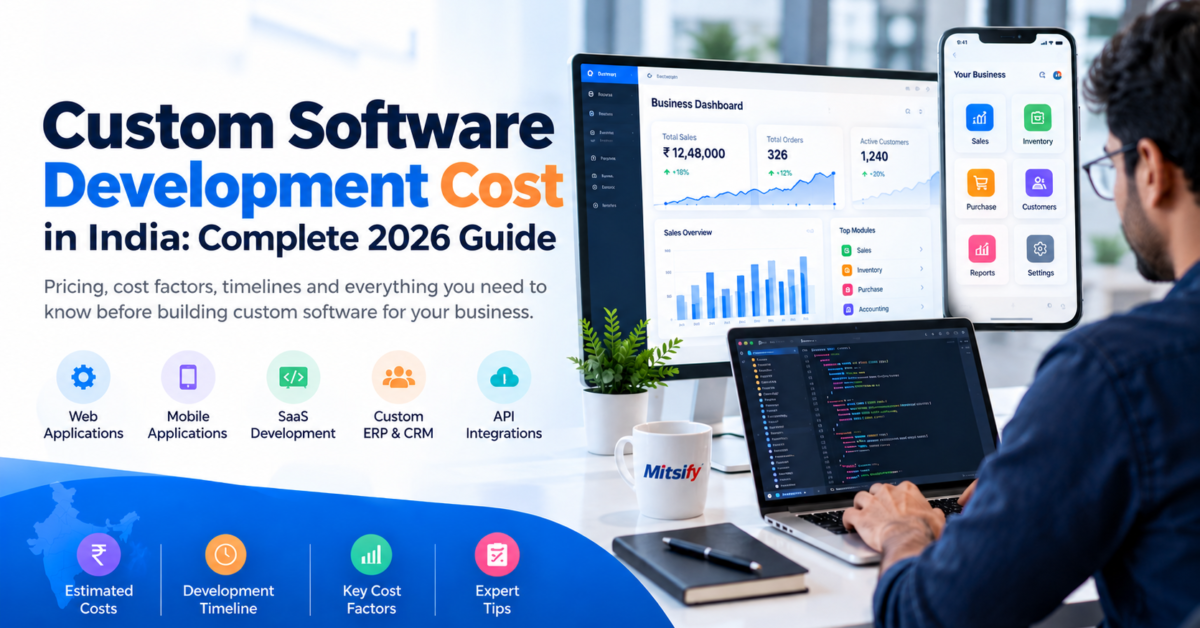
How much does custom software development cost in India in 2026?
The cost of custom software development in India can range from a few lakh rupees for a focused business application to several tens of lakhs or more for complex SaaS platforms, ERP systems, enterprise applications, and software with multiple integrations.
The final cost depends on several factors, including features, business logic, user roles, UI/UX, integrations, security, scalability, mobile applications, testing, deployment, and ongoing maintenance.
If you are planning to build custom software for your business, this guide explains custom software development cost in India in 2026, the factors that influence pricing, typical development timelines, and how to plan your software development budget.
Quick Answer: How Much Does Custom Software Development Cost in India?
As a general planning range, businesses may see software development budgets such as:
| Software Type | Approximate Cost in India | Typical Timeline |
|---|---|---|
| Simple Business Application | ₹2 – ₹5 lakh+ | 4 – 8 weeks |
| Custom CRM / Inventory System | ₹4 – ₹12 lakh+ | 2 – 5 months |
| Business Web Application | ₹5 – ₹18 lakh+ | 3 – 7 months |
| SaaS MVP | ₹5 – ₹15 lakh+ | 2 – 5 months |
| Custom ERP | ₹8 – ₹30 lakh+ | 4 – 9 months |
| Mobile App + Backend | ₹5 – ₹20 lakh+ | 3 – 7 months |
| Multi-Module SaaS Platform | ₹15 – ₹40 lakh+ | 5 – 12 months |
| Enterprise Software | ₹30 lakh – ₹1 crore+ | 6 – 18+ months |
These are indicative planning ranges, not fixed quotations. The actual cost depends on the project’s scope, complexity, features, integrations, technology requirements, and development approach.
A proper estimate requires understanding the business workflow, required features, number of users, platforms, integrations, and technical requirements.
What Is Custom Software Development?
Custom software development means building software specifically for the requirements of a particular business instead of using a generic off-the-shelf application.
For example, a business may need software for:
- Customer management
- Sales and billing
- Inventory management
- Purchase management
- Employee management
- Accounting integration
- Order management
- Business reports
- Multi-branch operations
- Customer portals
- Vendor management
- Workflow automation
- Mobile applications
- SaaS products
Instead of changing the business process to match an existing software package, custom development allows the software to be designed around the company’s actual workflow.
Why Does Custom Software Cost Different Amounts?
There is no single price for custom software development.
A simple internal application with a few forms and reports may require significantly less development work than a multi-branch ERP with different user roles, payment integrations, APIs, analytics, mobile apps, and real-time data.
The major cost factors include:
- Project complexity
- Number of features
- User roles and permissions
- UI/UX requirements
- Backend development
- Database architecture
- Third-party integrations
- Mobile application requirements
- Security requirements
- Testing and quality assurance
- Cloud infrastructure
- Maintenance and support
1. Project Complexity
Complexity is one of the biggest factors affecting software development cost.
Simple Software
Examples include:
- Internal dashboards
- Basic employee management
- Simple CRM
- Lead management systems
- Basic booking systems
These projects usually have fewer workflows and integrations.
Medium-Complexity Software
Examples include:
- Inventory management software
- Custom CRM
- Business management systems
- Customer portals
- Order management platforms
These applications may require multiple modules, user roles, reports, notifications, and integrations.
Complex Software
Examples include:
- Enterprise ERP
- Multi-branch business software
- SaaS platforms
- Marketplace platforms
- Financial applications
- Large workflow automation systems
These systems can require advanced architecture, multiple integrations, scalability, security, audit trails, and extensive testing.
2. Features and Modules
The number and complexity of features directly affect development effort.
For example, a basic CRM might include:
- Login
- Customer management
- Lead management
- Dashboard
- Reports
A more advanced CRM could require:
- Multiple user roles
- Sales pipelines
- Automated follow-ups
- WhatsApp integration
- Email integration
- Payment integration
- Advanced reports
- Notifications
- Activity tracking
- Audit logs
Therefore, two CRM projects can have completely different development costs.
3. UI/UX Design
Professional UI/UX design is another component of the software development budget.
The design process can include:
- User research
- User flows
- Wireframes
- Prototypes
- Desktop design
- Mobile-responsive design
- Design systems
- Usability improvements
A software product that will be used by customers or sold as SaaS generally needs more attention to user experience than a small internal application.
4. Backend and Database Development
The backend is responsible for the core business logic of the application.
It can include:
- Authentication
- User management
- Database design
- APIs
- Business rules
- Data processing
- Notifications
- Background jobs
- Reports
- File management
- Integrations
For applications with complex business rules, backend architecture can represent a significant portion of the development effort.
5. Third-Party Integrations
Integrations can significantly increase development scope.
Examples include:
- Payment gateways
- GST-related systems
- Accounting software
- CRM platforms
- WhatsApp APIs
- SMS gateways
- Email services
- Google Maps
- Shipping APIs
- ERP systems
- Banking APIs
- Cloud services
Adding one basic API integration is very different from integrating several external systems with authentication, synchronisation, error handling, logging, and scheduled data transfers.
6. Number of Users and User Roles
A simple application with one user type is easier to build than software with multiple roles.
A business application may have:
- Super Admin
- Admin
- Manager
- Sales Executive
- Accountant
- Customer
- Vendor
Each role may require different:
- Permissions
- Dashboards
- Screens
- Actions
- Reports
- Approval workflows
Role-based access control can therefore add development and testing requirements.
7. Web Application vs Mobile Application
The required platforms also influence cost.
You might need:
- Web application
- Android application
- iOS application
- Admin panel
- Customer portal
- Backend APIs
If your business requires both web and mobile applications, the development scope becomes larger than building a single web application.
For some projects, cross-platform mobile development can reduce duplicated development effort, depending on the requirements and technology chosen.
8. Security Requirements
Security becomes especially important when software handles sensitive business or customer data.
Security requirements may include:
- Secure authentication
- Role-based permissions
- Encryption
- API security
- Session management
- Audit logs
- Backup systems
- Access controls
- Secure cloud infrastructure
Enterprise and customer-facing applications generally require more extensive security planning and testing.
9. Testing and Quality Assurance
Software development isn’t complete when the code is written.
A production-ready application needs testing for:
- Functional issues
- UI issues
- Mobile responsiveness
- API behaviour
- Database operations
- User permissions
- Security
- Performance
- Browser compatibility
- Edge cases
Skipping proper testing can reduce the initial development cost but may increase the cost of fixing problems after launch.
10. Cloud Hosting and Deployment
After development, the application needs an environment where it can run.
Depending on the project, this may include:
- Cloud server
- Database server
- Storage
- Domain
- SSL
- CDN
- Email service
- Backup
- Monitoring
- Deployment pipeline
Cloud infrastructure costs are generally separate from the one-time software development cost and depend on usage and architecture.
Custom Software Development Cost by Project Type
Simple Business Application
Estimated budget: ₹2 – ₹5 lakh+
Suitable for:
- Small internal tools
- Basic management applications
- Simple dashboards
- Basic workflow systems
Typical features:
- Login
- Dashboard
- Forms
- Basic database
- Reports
- User management
Custom CRM
Estimated budget: ₹4 – ₹12 lakh+
A custom CRM may include:
- Lead management
- Customer management
- Sales pipeline
- Follow-ups
- Tasks
- Notifications
- Reports
- User roles
More advanced CRM platforms with multiple integrations can cost considerably more.
Inventory Management Software
Estimated budget: ₹5 – ₹15 lakh+
Possible features include:
- Product management
- Stock management
- Purchase
- Sales
- Stock adjustments
- Barcode support
- Supplier management
- Reports
- Multi-location inventory
The actual budget depends heavily on workflow complexity and integrations.
Custom ERP Software
Estimated budget: ₹8 – ₹30 lakh+
A custom ERP may include:
- Sales
- Purchase
- Inventory
- Accounting
- HR
- CRM
- Reports
- User management
- Multi-branch operations
A large ERP with complex integrations, multiple business units, and extensive customisation can exceed this range.
SaaS Product
Estimated budget: ₹5 – ₹40 lakh+
A SaaS application may require:
- Customer registration
- Subscription plans
- Billing
- Multiple organisations
- Multi-tenancy
- User roles
- Admin dashboard
- Notifications
- Payment gateway
- Usage tracking
- APIs
The architecture required for multi-tenant SaaS can significantly increase the development scope.
What Does a ₹5 Lakh vs ₹20 Lakh Software Project Look Like?
The difference isn’t simply the number of pages.
Around ₹5 Lakh
A focused application might contain:
- 1–3 major modules
- Basic UI/UX
- Limited user roles
- Basic reports
- Few integrations
- Web application
- Standard security requirements
Around ₹20 Lakh
A larger application might include:
- Multiple business modules
- Advanced workflows
- Multiple user roles
- Complex reports
- Several API integrations
- Advanced permissions
- Customer portal
- Mobile application
- Extensive testing
- Production deployment
The actual scope matters more than the budget number itself.
Hidden Costs to Consider
When comparing software quotations, don’t look only at the development price.
Ask whether the quotation includes:
Discovery and Requirement Analysis
Understanding business workflows before development.
UI/UX Design
Wireframes, prototypes and final interface design.
Testing
Manual and automated testing where appropriate.
Deployment
Production setup and release.
Data Migration
Moving data from existing software, Excel files, or databases.
Training
Helping employees understand the new system.
Maintenance
Bug fixes, updates and technical support after launch.
Third-Party Services
Payment gateways, SMS, WhatsApp, hosting, email services and other external platforms may have separate charges.
Fixed Price vs Time & Material Development
There are several ways software development projects can be priced.
Fixed Price
The project is agreed around a defined scope and price.
Suitable for:
- Clearly defined projects
- Fixed requirements
- Smaller applications
Advantage: You have a clearer upfront budget.
Limitation: Changes to the agreed scope may require additional estimates.
Time & Material
You pay based on the actual development effort.
Suitable for:
- Long-term projects
- SaaS products
- Projects where requirements evolve
Advantage: More flexibility to change and improve features during development.
Limitation: The final cost can change as the scope evolves.
How Long Does Custom Software Development Take?
Development timelines depend on project scope.
A rough planning framework is:
- Simple application: 4–8 weeks
- Medium business application: 2–6 months
- Custom ERP: 4–9+ months
- SaaS platform: 5–12+ months
- Enterprise platform: 6–18+ months
These are planning ranges rather than guarantees. Requirements, feedback cycles, integrations, testing, and approval timelines can all affect delivery.
How to Reduce Custom Software Development Cost
You don’t necessarily need to reduce the quality of the software to control your budget.
Instead:
1. Start with an MVP
Build the most important features first.
2. Prioritise Features
Separate requirements into:
- Must have
- Should have
- Could have
- Future requirements
3. Avoid Unnecessary Integrations
Only integrate external systems that are actually required.
4. Define Requirements Early
Clear requirements can reduce rework and scope changes.
5. Build in Phases
Instead of developing everything at once:
- Phase 1: Core software
- Phase 2: Advanced features
- Phase 3: Mobile applications and integrations
- Phase 4: Automation and analytics
6. Choose Technology Based on Requirements
Don’t choose a technology simply because it is popular. The technology should fit the application’s requirements, maintainability, scalability, and team expertise.
How to Choose a Custom Software Development Company in India
Before selecting a development company, ask:
- Have they built similar software?
- Can they understand your business workflow?
- Do they provide UI/UX design?
- How do they handle testing?
- What technology will they use?
- Will you own the source code?
- What happens after launch?
- What is included in the quotation?
- How are scope changes handled?
- Do they provide maintenance and support?
Don’t compare vendors only by the lowest quotation.
Compare the scope, development approach, technology, testing, support, ownership, and expected long-term cost.
Custom Software vs Off-the-Shelf Software
The right choice depends on your business requirements.
| Factor | Custom Software | Off-the-Shelf Software |
|---|---|---|
| Customisation | High | Limited |
| Initial Cost | Usually higher | Usually lower |
| Business Workflow | Built around your process | Adapt to existing process |
| Scalability | Can be designed for requirements | Depends on vendor |
| Integrations | Customisable | Depends on available integrations |
| Ownership | Can be contractually arranged | Usually vendor-controlled |
| Development Time | Longer | Faster to start |
If your requirements are already well covered by an existing product, buying software may make more sense.
If your business has unique workflows or needs a specialised system, custom development can be considered.
Is Custom Software Worth the Investment?
Custom software can be useful when it solves a specific business problem that existing software cannot address effectively.
Potential benefits include:
- Better workflow automation
- Reduced manual work
- Centralised business data
- Custom reporting
- Better integration between systems
- Improved operational visibility
- Support for unique business processes
- Ability to build a scalable product
However, businesses should evaluate the expected business value, total cost of ownership, implementation effort, and long-term maintenance before starting development.
Why Choose Mitsify for Custom Software Development?
At Mitsify, we develop custom software solutions based on specific business requirements rather than forcing businesses into a standard workflow.
Our development approach can cover:
- Business requirement analysis
- UI/UX design
- Web application development
- Custom software development
- Mobile application development
- API development and integration
- SaaS development
- Database development
- Testing and deployment
- Ongoing maintenance and support
We work with businesses that need software for specific workflows, internal operations, customer-facing applications, and business automation.
Planning a Custom Software Project?
Instead of estimating the cost from the number of screens alone, start with your actual business requirements.
Book a free consultation with Mitsify and discuss your software requirements with our team.
Frequently Asked Questions
How much does custom software development cost in India in 2026?
Custom software development can range from a few lakh rupees for a simple business application to ₹30 lakh, ₹50 lakh or more for complex SaaS, ERP and enterprise platforms. The actual cost depends on scope, features, integrations, platforms and technical requirements.
What is the minimum cost of custom software development in India?
A simple custom application may start around ₹2–5 lakh, depending on the requirements and development team. Very small projects, prototypes, or low-code solutions can have different budgets.
How much does a custom ERP cost in India?
A custom ERP can start around ₹8 lakh and increase to ₹30 lakh or significantly more depending on the number of modules, branches, users, integrations, reports and business workflows.
How much does SaaS development cost in India?
A focused SaaS MVP may start around ₹5–15 lakh, while a multi-module SaaS platform can require ₹15–40 lakh or more depending on multi-tenancy, billing, integrations, security and scalability requirements.
How long does custom software development take?
A simple application may take 4–8 weeks, while medium and complex applications can take several months. Enterprise platforms may require 6–18 months or more.
Is custom software better than ready-made software?
Neither option is automatically better. Ready-made software can be suitable when its features match your business requirements. Custom software can be useful when your workflows, integrations or requirements are not well supported by existing products.
Can I develop custom software in phases?
Yes. Developing an MVP first and adding advanced features in later phases can help businesses manage budget, validate requirements and launch sooner.
Does custom software development include maintenance?
Not always. Maintenance and support should be clearly mentioned in the development agreement. Hosting, third-party services, support, updates and ongoing development may be charged separately.
Final Thoughts
The custom software development cost in India in 2026 depends primarily on the scope and complexity of the project.
A simple business application may require a few lakh rupees, while a complex SaaS, ERP or enterprise platform can require tens of lakhs or more.
The best way to estimate your budget is to define:
Business requirements → Features → User roles → UI/UX → Integrations → Technology → Testing → Deployment → Maintenance
Rather than asking only, “How much does software development cost?”, ask:
“What software does my business actually need, and what should the first version include?”
A well-defined scope makes it much easier to create a realistic budget and development plan.
Need a custom software development estimate for your business?
Contact Mitsify to discuss your requirements and plan your project →