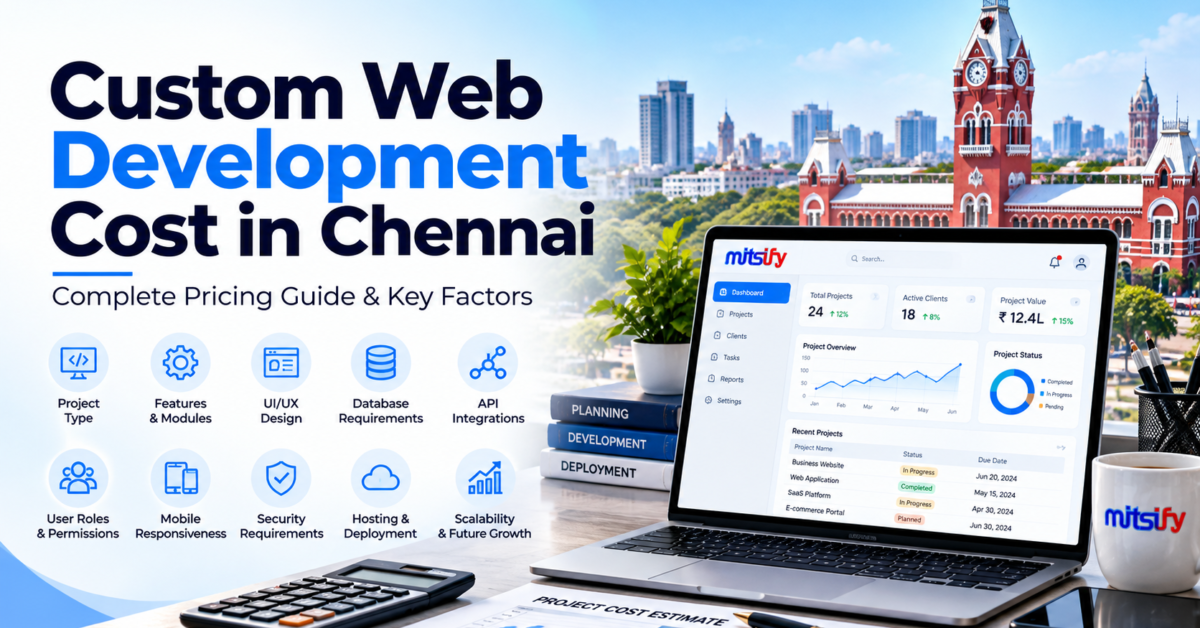
If you are planning to build a custom website or web application, one of the first questions is usually: How much does custom web development cost in Chennai?
The answer depends on the type of project, number of features, technology requirements, integrations, design complexity, and long-term scalability.
A simple business website and a custom SaaS application can have completely different development requirements. Therefore, instead of looking at a single fixed price, businesses should first understand the factors that influence custom web development cost.
What Is Custom Web Development?
Custom web development involves building a website or web application specifically around a business’s requirements.
Unlike a standard template-based website, a custom solution can include business-specific workflows, dashboards, user roles, databases, APIs, integrations, automation and custom functionality.
Common examples include:
- Business web applications
- Customer portals
- SaaS platforms
- Admin dashboards
- E-commerce applications
- CRM systems
- Inventory management systems
- ERP integrations
- Booking platforms
- Workflow automation systems
What Factors Affect Custom Web Development Cost?
There is no single fixed price for every custom web development project.
The overall development cost can depend on several factors.
1. Project Type
The type of application is one of the biggest factors.
A basic corporate website requires fewer development resources than a business application with multiple user roles, dashboards and integrations.
For example:
Basic business website
Usually has informational pages, contact forms and basic content management.
Custom web application
May include login, dashboards, user roles, database operations and business workflows.
SaaS platform
Can require subscriptions, multi-user access, tenant management, billing, APIs, dashboards and scalability.
The complexity increases as more functionality is introduced.
2. Number of Features and Modules
The number of modules directly affects development effort.
A custom application may include:
- User management
- Role and permission management
- Dashboard
- Reports
- Notifications
- Search
- Filters
- Billing
- Inventory
- Customer management
- Admin management
- Analytics
More modules generally mean more design, development, testing and maintenance requirements.
3. UI/UX Design Requirements
A custom application requires more than just development.
The user interface needs to be planned around the users and their workflows.
UI/UX work can include:
- Wireframes
- User flows
- Dashboard design
- Responsive layouts
- Mobile layouts
- Forms
- Navigation
- Interactive components
A well-planned interface can make complex business applications easier to use.
4. Database Requirements
Applications that store large amounts of business information require proper database planning.
Depending on the application, the database may need to handle:
- Customers
- Products
- Orders
- Transactions
- Employees
- Reports
- Documents
- User activity
- Business records
Database structure, relationships, queries and performance can all influence development requirements.
5. API and Third-Party Integrations
Many businesses need their applications to communicate with other platforms.
Examples include:
- Payment gateways
- SMS services
- Email services
- Accounting software
- CRM systems
- Shipping platforms
- Social platforms
- External business APIs
Each integration needs development, testing and error handling.
Therefore, projects with multiple integrations may require additional development time and resources.
6. User Roles and Permissions
Business applications often have different types of users.
For example:
- Super Admin
- Admin
- Manager
- Staff
- Customer
- Vendor
Each role may have different access permissions.
A complex permission structure requires additional planning and development.
7. Mobile Responsiveness
Modern web applications need to work across different screen sizes.
The application may need to support:
- Desktop
- Laptop
- Tablet
- Mobile
Responsive design ensures that users can access the application conveniently across devices.
8. Security Requirements
Security is another important consideration for business applications.
Depending on the project, security requirements may include:
- Secure authentication
- Role-based access
- Password protection
- Data validation
- API security
- Session management
- Database security
- Backup systems
Applications handling sensitive business information may require additional security measures.
9. Technology Stack
The technology stack can also influence the development process.
Depending on the requirements, a project may use technologies such as:
- Laravel
- PHP
- React
- JavaScript
- MySQL
- REST APIs
- Cloud platforms
The technology should be selected based on the project’s requirements, scalability and maintenance needs.
10. Hosting and Deployment
Development is only one part of launching a web application.
The project may also require:
- Domain configuration
- Hosting
- SSL
- Server setup
- Database deployment
- Email configuration
- Cloud infrastructure
- Backup configuration
- Monitoring
These requirements should be considered when planning the overall project budget.
Custom Website vs Custom Web Application
One important distinction is between a custom website and a custom web application.
Custom Website
A business website may mainly focus on:
- Company information
- Services
- Products
- Blog
- Contact forms
- Lead generation
Custom Web Application
A web application can include:
- User login
- Dashboards
- Database
- Business workflows
- Reports
- User roles
- APIs
- Automation
- Custom modules
Because the functionality is different, development requirements and costs can vary significantly.
How to Reduce Unnecessary Development Costs
Businesses do not necessarily need to build every possible feature in the first version.
A better approach can be to define the essential requirements first.
Start With the Core Requirements
Identify the features that are necessary for launch.
Build an MVP
For startups and new software products, an MVP can help validate the idea before investing in advanced functionality.
For businesses planning a SaaS product, SaaS Development can provide a scalable approach for building and expanding the application.
Plan Integrations Carefully
Only integrate the external systems that are required for the initial version.
Design Before Development
Proper UI/UX planning can reduce unnecessary development changes later.
Plan for Future Expansion
The initial architecture should allow important features to be added later without rebuilding the entire application.
Why Choose a Custom Web Development Company in Chennai?
Chennai has businesses across technology, retail, manufacturing, healthcare, education, finance and professional services.
Different businesses often have different workflows and software requirements.
A local development partner can work closely with the business to understand:
- Business processes
- User requirements
- Technical requirements
- Integrations
- Reporting requirements
- Future expansion
However, the development partner should be selected based on relevant experience, technical capability, development process and support rather than location alone.
Custom Web Development Services by Mitsify
Mitsify provides custom web development services for businesses that require tailored digital solutions.
Our capabilities include:
- Custom web applications
- Business management systems
- SaaS platforms
- Customer portals
- Admin dashboards
- E-commerce applications
- API integrations
- Database-driven applications
- Workflow automation
The development approach can be planned according to the project’s requirements, users, business workflows and future scalability.
Frequently Asked Questions
How much does custom web development cost in Chennai?
The cost depends on the project type, features, design requirements, integrations, database complexity, security requirements and development scope.
Is custom web development more expensive than a ready-made website?
Custom development can require more initial development work because the application is built around specific requirements. However, the appropriate option depends on the business’s needs.
How long does custom web development take?
The timeline depends on the number of modules, features, integrations, UI/UX requirements and testing scope.
Can I start with a small version of my application?
Yes. Businesses and startups can begin with an MVP containing essential features and expand the application later.
Can Mitsify develop a custom web application in Chennai?
Yes. Mitsify provides custom web development services for businesses in Chennai and across India.
Conclusion
Custom web development cost depends on much more than the number of pages in a website.
Features, business workflows, UI/UX, database architecture, APIs, integrations, security, hosting and scalability can all influence the overall development effort.
Before requesting a quotation, clearly define the required features and expected user workflow. This makes it easier to create an accurate project scope and development estimate.
If you are planning a custom website, web application or SaaS platform, Mitsify can help you discuss the requirements and plan a suitable development approach.
Planning a custom web application? Contact Mitsify to discuss your requirements.