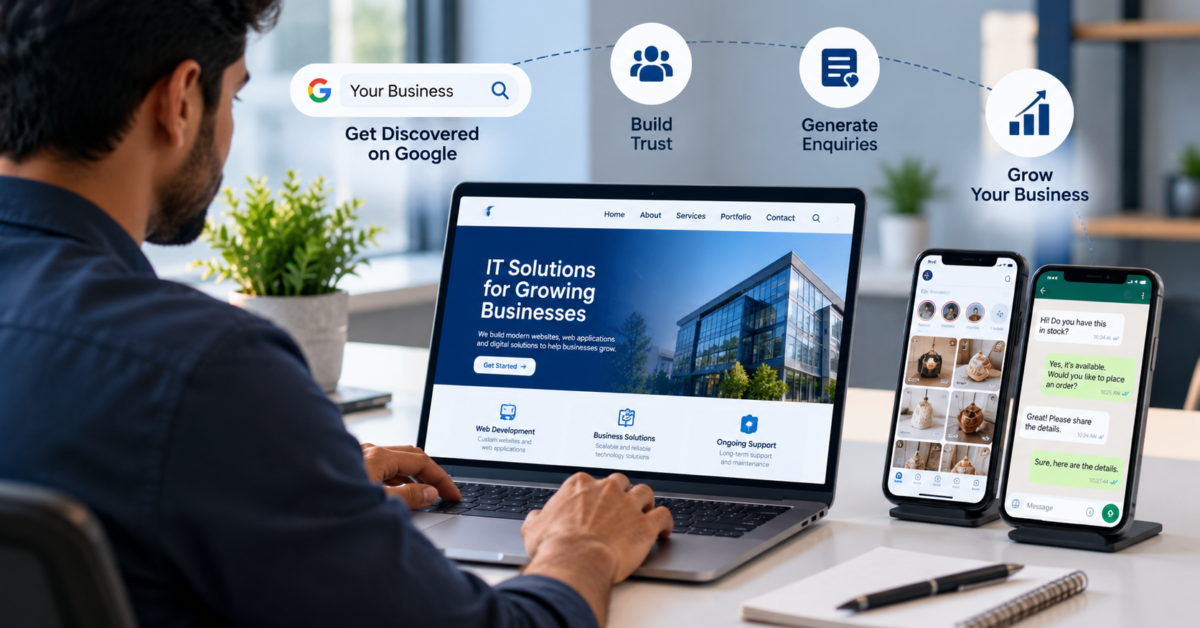
Many small businesses today run successfully through Instagram, WhatsApp, Facebook, and other social media platforms. They share product photos, post videos, respond to customer enquiries, and receive orders without having a website.
So, does every small business really need a website in 2026?
The answer is no—not every business needs a website immediately. However, a website can become a valuable business asset when a company wants to reach new customers, build credibility, showcase its products or services, and generate enquiries through Google.
The right decision depends on your business model, target customers, growth plans, and the limitations of your current sales process.
In this article, we will explore when social media is enough, when a website makes sense, and how small businesses can decide whether investing in one is worthwhile.
1. Why Do Many Small Businesses Prefer Instagram and WhatsApp?
Instagram and WhatsApp make it easy for small businesses to start selling online.
A business owner can create an Instagram profile, publish product photos, share Reels, answer questions through direct messages, and use WhatsApp to communicate with customers.
These platforms are particularly useful for businesses that depend on visual content, personal relationships, repeat customers, and direct conversations.
For example, a small clothing boutique can display new collections on Instagram and accept orders through WhatsApp. A home baker can share cake designs and receive custom orders through messages.
For businesses like these, social media can be an effective starting point.
However, social media and a business website serve different purposes. Social media helps businesses attract attention and communicate with customers, while a website can provide a central place for detailed information, product catalogues, service descriptions, enquiries, and online transactions.
The goal is not necessarily to replace Instagram or WhatsApp. It is to decide whether adding a website would improve the way your business operates.
2. What Are the Benefits of Having a Business Website?
A well-planned website can support several business goals.
Get Discovered Through Google Search
Customers often search online before choosing a service provider or purchasing a product.
For example, someone might search for a website developer in Chennai, an industrial equipment supplier, or a company that provides business software.
A search-engine-optimised website gives a business an opportunity to appear for relevant searches.
However, simply creating a website does not guarantee Google rankings or traffic. Search visibility depends on factors such as useful content, competition, technical accessibility, and the relevance of the website to the search.
Present Your Business Professionally
A website can bring your company profile, services, portfolio, contact information, customer testimonials, and frequently asked questions together in one place.
Potential customers can learn about your business without having to request every detail through a WhatsApp conversation.
For B2B companies, manufacturers, consultants, and professional service providers, this information can help potential buyers evaluate whether the business meets their requirements.
Generate Customer Enquiries
A website can include enquiry forms, quotation requests, appointment booking, demo requests, and WhatsApp contact buttons.
For example, a software development company can explain its services, display relevant project examples, and allow potential clients to submit their project requirements through a form.
This creates a structured way to collect enquiries and follow up with potential customers.
Showcase Products and Services
Businesses with many products or service packages may find it difficult to communicate every detail through social media posts alone.
A website can organise products into categories, display specifications, explain features, and provide downloadable catalogues.
Manufacturers and distributors can use this approach to present product information to potential dealers, retailers, and business buyers.
Build a Digital Presence That You Control
Social media platforms have their own rules, features, and algorithms. Their functionality and reach can change over time.
A business website gives the company more control over its content, page structure, domain name, and customer journey.
This does not mean abandoning social media. Instead, the business can use social media to attract attention and its website to provide more detailed information and encourage enquiries.
3. Website vs Instagram vs WhatsApp: Which Is Better?
There is no single platform that works best for every business.
| Business need | Website | ||
|---|---|---|---|
| Share photos and videos | Excellent | Useful | Useful |
| Direct customer conversations | Available | Excellent | Usually needs an integrated contact option |
| Organise detailed service information | Limited | Limited | Excellent |
| Appear in relevant Google searches | Limited control | Limited control | Possible with SEO |
| Display a structured product catalogue | Useful | Useful | Excellent for larger catalogues |
| Collect detailed project enquiries | Possible | Possible | Can use dedicated forms |
| Support online transactions | Depends on setup and availability | Depends on setup | Can support ecommerce and payment integration |
| Control content and page structure | Platform-dependent | Platform-dependent | Greater control |
The best choice depends on what your customers need and how they prefer to interact with your business.
For many small businesses, combining these platforms works better than choosing only one.
For example, Instagram can attract potential customers, WhatsApp can support quick conversations, and the website can explain the business in detail and collect enquiries.
4. When Is Instagram and WhatsApp Enough?
A website may not be an immediate priority if your current process is working well.
You may be able to continue using social media and messaging platforms if:
- Most customers discover your business through referrals or social media.
- Your product range is small and easy to explain.
- You handle orders and enquiries comfortably through direct messages.
- Your business does not depend on Google search traffic.
- You do not need online bookings, detailed product pages, or automated workflows.
- Your current sales process is producing satisfactory results.
For example, a home-based business that receives regular orders through referrals and WhatsApp may not need to invest in a complex website immediately.
Instead, the owner could focus on improving product presentation, customer service, pricing, and repeat purchases.
A business should not invest in a website simply because other companies have one. It should invest when there is a clear business objective.
5. Signs Your Small Business May Need a Website
As your business grows, your existing methods may become less effective.
Consider building a website if you recognise any of the following situations.
You Want to Reach Customers Who Do Not Know Your Business
If you depend entirely on existing customers, referrals, or social media followers, you may have limited opportunities to reach people searching for your products or services.
A properly optimised website can help you target relevant search queries and reach potential customers who are actively looking for solutions.
Customers Frequently Ask for the Same Information
If customers repeatedly ask about pricing, service details, product specifications, delivery options, or company information, a website can answer many of these questions in one place.
This can make the buying process easier for customers and reduce repetitive conversations.
You Want to Work With Larger Businesses
Corporate buyers and procurement teams may want to review your company profile, services, certifications, product specifications, or project experience before contacting you.
A professional website can make this information easier to access.
Your Business Has a Large Product or Service Catalogue
If your business offers dozens or hundreds of products, maintaining a structured online catalogue may be more convenient than relying only on individual social media posts.
Depending on your needs, you could also add search, filters, quotation requests, or ecommerce functionality.
You Want to Automate Part of Your Sales Process
A website can be integrated with forms, customer relationship management systems, booking tools, payment gateways, and other business applications.
These integrations can help organise enquiries and reduce manual work.
6. What Type of Website Does a Small Business Need?
Not every business requires an expensive or complex web application.
The right solution depends on the business objective.
Business Website
Suitable for consultants, agencies, professional services, and companies that need to present their services, portfolio, contact information, and company profile.
Product Catalogue Website
Suitable for manufacturers, wholesalers, distributors, and retailers who want to display products and receive enquiries without necessarily accepting online payments.
Ecommerce Website
Suitable for businesses that want customers to browse products, place orders, make payments, and receive order updates online.
Custom Web Application
Suitable for businesses that need more than a standard website, such as customer portals, inventory systems, workflow automation, reporting dashboards, or integrations between multiple systems.
If your requirement involves complex workflows, a custom web application may be more appropriate than a basic business website.
You can explore custom web development services from Mitsify to understand how a solution can be planned around specific business requirements.
7. How Much Should a Small Business Spend on a Website?
Website costs vary depending on the required features, design, content, integrations, maintenance, and complexity.
A basic business website may be sufficient for a company that only needs service pages and contact details. A product catalogue, ecommerce store, or custom application will generally require more planning and development.
Before requesting a quotation, identify:
- The primary goal of the website.
- The pages and features you need.
- Whether you need online payments, bookings, or integrations.
- Who will prepare and update the content.
- The expected hosting, domain, and maintenance costs.
- How you plan to attract visitors after launch.
Do not evaluate a website only by its initial development cost. Consider its expected business value and the ongoing resources required to maintain it.
For a small business, the best investment is usually the simplest solution that meets its real requirements and allows for future growth.
8. How Can a Website Work With Instagram and WhatsApp?
A website does not have to operate separately from your existing channels.
You can connect your online presence through a simple customer journey:
- A potential customer discovers your business through Instagram, Google, a referral, or an advertisement.
- The customer visits your website to understand your products or services.
- The customer submits an enquiry, requests a quotation, books an appointment, or contacts you through WhatsApp.
- Your business responds, qualifies the requirement, and follows up.
- You track which channels are generating useful enquiries and improve your marketing accordingly.
You can also add WhatsApp contact buttons to relevant pages, link to your social media profiles, and use analytics tools to measure website visits and enquiry submissions.
The objective is to make it easier for customers to move from discovering your business to taking the next step.
9. How to Decide Whether Your Business Needs a Website in 2026
Before investing in a website, ask yourself five questions:
- Do I want to reach customers beyond my existing social media audience?
- Do potential customers need detailed information before contacting me?
- Would a searchable product or service catalogue make buying easier?
- Could enquiry forms, bookings, or integrations reduce manual work?
- Can I identify a realistic way to measure the website’s contribution to my business?
If most answers are no, you may not need a website immediately.
If several answers are yes, it may be worth exploring a website or web application that addresses those specific needs.
Start with a clear business goal, such as increasing qualified enquiries, supporting B2B sales, improving customer communication, or simplifying a repetitive process.
Then choose the features and technology that support that goal.
Conclusion
Small businesses do not automatically need a website just because they operate in 2026. Instagram and WhatsApp can be effective channels for attracting customers, building relationships, and handling sales.
However, a website can provide additional value when a business wants to improve its Google visibility, present detailed information, reach new markets, organise product catalogues, or generate structured enquiries.
The right decision is not about choosing between social media and a website. It is about understanding what your business needs and choosing the tools that help you achieve those goals.
If you are considering a website for your business, start by identifying your customers, the problem you want to solve, and the outcome you expect.
Need a website or custom web application for your business? Mitsify Web Development LLP can help you explore a solution based on your business requirements.
Explore Mitsify’s custom web development services or visit Mitsify to learn more.
Frequently Asked Questions
1. Is a website necessary for every small business?
No. Some small businesses can operate successfully through referrals, Instagram, WhatsApp, or local customers. A website becomes more valuable when the business needs search visibility, detailed information pages, online enquiries, or additional digital functionality.
2. Can I run my business using only Instagram and WhatsApp?
Yes, depending on your business model. These platforms can be sufficient for some businesses. However, you may need additional tools as your product range, customer base, or operational requirements grow.
3. Does having a website guarantee customers?
No. A website does not guarantee leads or sales. Results depend on the relevance of the offering, website usability, marketing, search visibility, competition, and how effectively enquiries are handled.
4. Can a website help my business appear on Google?
Yes. Search-engine-friendly pages can appear for relevant Google searches. However, indexing and rankings are not guaranteed, and results depend on content quality, technical accessibility, competition, and other factors.
5. Should I build a website or a mobile app first?
For many businesses, a website is a practical starting point because customers can access it through a browser without installing an application. A mobile app may make sense when frequent usage, device-specific features, or other requirements justify the additional investment.
6. Can a website connect to WhatsApp?
Yes. A website can include WhatsApp contact links or buttons. More advanced integrations may require additional configuration, APIs, or third-party services.
7. How do I choose the right website development company?
Review relevant project experience, technical capabilities, communication, scope of work, ownership terms, security practices, support arrangements, and the total expected cost. Choose a developer who understands your business goals rather than simply offering the largest number of features.