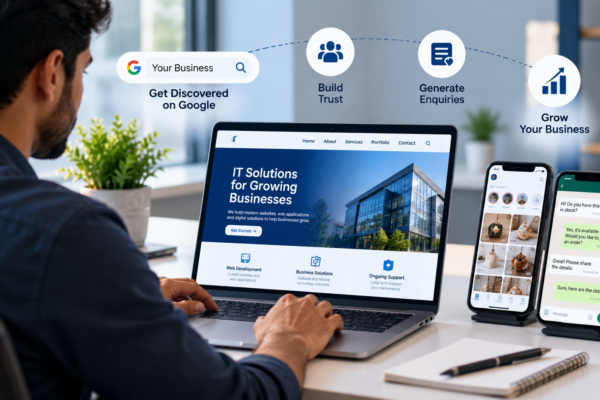
Many small businesses use Instagram and WhatsApp to promote their products, communicate with customers, and receive orders. Some businesses also maintain a website to showcase their services, attract visitors from Google, and generate enquiries.
But if you are running a small business, which option is best: a website, Instagram, or WhatsApp?
The answer depends on your business goals, target audience, budget, and how customers discover and purchase your products or services.
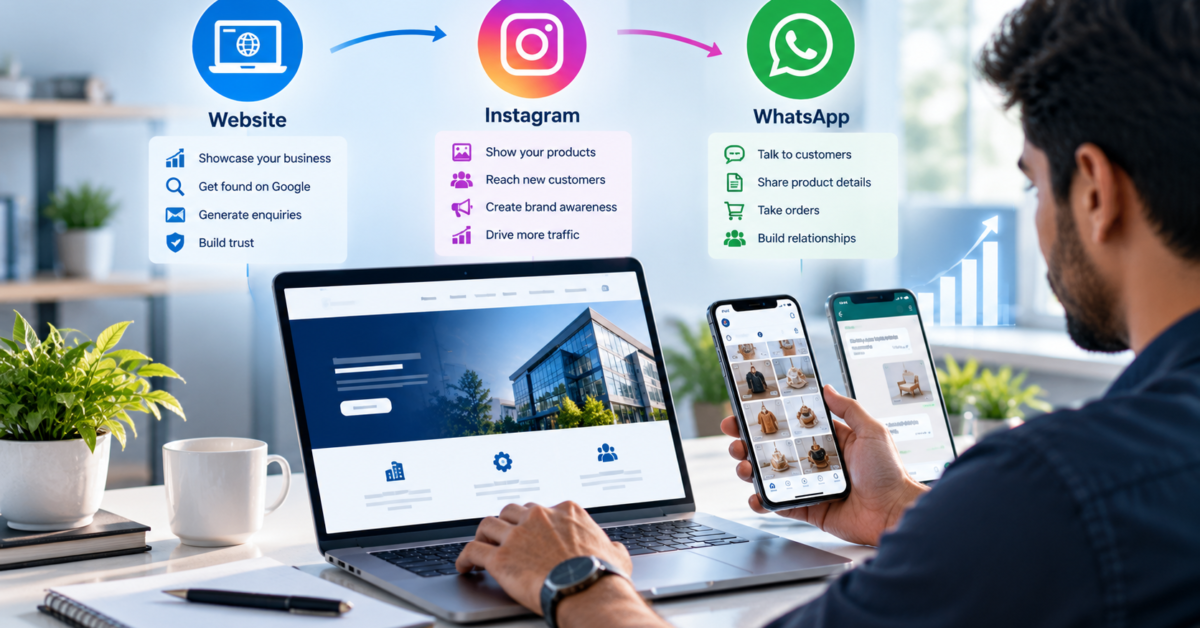
Instagram helps businesses attract attention, WhatsApp makes customer communication convenient, and a website provides a central place to present information and generate enquiries. These channels can work together rather than compete with one another.
In this guide, we compare their advantages and limitations and explain how to choose the right approach for your business.
1. What Is the Difference Between a Website, Instagram, and WhatsApp?
Although all three can support online business activities, they serve different purposes.
Website: Your Business Information Hub
A business website is an online destination where customers can learn about your company, explore your products or services, review your portfolio, and contact your team.
Depending on your requirements, it can include product catalogues, enquiry forms, quotation requests, appointment booking, online payments, and customer portals.
A website also gives you greater control over how your business information is organised and presented.
Instagram: Your Product Discovery and Marketing Channel
Instagram helps businesses reach audiences through photos, Reels, Stories, and other social content.
It is particularly useful for businesses that benefit from visual presentation, including clothing stores, restaurants, jewellery retailers, beauty services, and lifestyle brands.
Customers can discover products, follow a business, interact with posts, and initiate conversations.
However, social media reach can fluctuate, and your content is displayed within a platform whose features and rules you do not fully control.
WhatsApp: Your Customer Communication Channel
WhatsApp is useful for answering customer questions, sharing product details, sending updates, and discussing orders.
WhatsApp Business offers features designed to support business communication, such as business profiles, product catalogues, and messaging tools, with availability depending on the product and configuration.
It is especially useful when customers prefer direct conversations before making a purchase.
However, managing large volumes of enquiries manually can become difficult as a business grows.
2. Website vs Instagram vs WhatsApp: Comparison Table
| Feature | Business Website | ||
|---|---|---|---|
| Main purpose | Information, enquiries and transactions | Discovery, engagement and promotion | Direct communication and follow-up |
| Google search visibility | Can rank for relevant searches with SEO | Public profiles and content may appear in search | Limited control over search visibility |
| Product presentation | Structured pages and catalogues | Visual posts, Reels and Stories | Product sharing and supported catalogues |
| Customer communication | Forms, calls, email and integrated messaging | Comments and direct messages | Direct messaging and business tools |
| Design and content control | Greater control | Platform-dependent | Platform-dependent |
| Online orders and payments | Can support custom checkout and integrations | Depends on available features and linked services | Depends on available payment features and setup |
| Best suited for | Detailed information, lead generation and digital services | Audience discovery and visual marketing | Customer conversations and order coordination |
No channel automatically guarantees customers or sales. Results depend on the business, the quality of its offering, the audience, and how effectively each channel is used.
3. When Is Instagram the Best Choice?
Instagram can be a strong starting point when your products or services are highly visual and your customers actively use the platform.
It may be particularly useful if:
- You sell clothing, jewellery, accessories, food, or handmade products.
- Your audience responds to photos, videos, demonstrations, and customer stories.
- You can publish useful content consistently.
- Customers discover your products through recommendations and social engagement.
- You primarily need a way to showcase products and begin conversations.
For example, a small clothing boutique can publish new collections, share styling videos, announce offers, and direct interested customers to WhatsApp.
However, if customers need detailed specifications, downloadable catalogues, service comparisons, or formal quotations, an Instagram profile alone may not provide the best experience.
4. When Is WhatsApp Best for Business?
WhatsApp is especially useful when customer conversations are an important part of your sales process.
It can help businesses:
- Answer product and service questions.
- Share photographs, documents, and quotations.
- Coordinate orders and delivery updates.
- Follow up with customers who have made enquiries.
- Maintain communication with existing customers.
For example, a home baker may receive a customer’s cake design, preferred date, and delivery details through WhatsApp before confirming an order.
But as the number of enquiries increases, conversations can become difficult to organise. Important requests may get buried in message history, and staff may struggle to track follow-ups.
A website with structured enquiry forms, booking features, or integrations may help address these issues, depending on the business requirements.
5. When Does Your Business Need a Website?
A website becomes worth considering when your current channels do not fully support your business goals.
You Want Customers to Discover You Through Google
Potential customers may search for a product, service, supplier, or solution without knowing your company name.
A website with useful, relevant content can give your business an opportunity to appear in those search results.
For example, a B2B company may create service pages explaining its capabilities, industries served, and project experience.
However, creating a website alone does not guarantee search rankings. SEO, competition, technical accessibility, and content quality all matter.
You Need to Present Detailed Information
If customers repeatedly ask about your services, pricing structure, product specifications, project experience, or company background, a website can organise that information in one accessible place.
This is particularly valuable for manufacturers, distributors, consultants, software companies, and other B2B businesses.
You Want More Structured Business Enquiries
A website can collect information through quotation forms, project requirement forms, demo requests, and appointment bookings.
For example, a software development company can ask visitors to describe their project, preferred technology, timeline, and contact details.
This can make it easier to review enquiries and follow up with potential customers.
You Want to Display a Large Product Catalogue
Businesses with many products may benefit from searchable categories, product specifications, downloadable catalogues, and enquiry options.
This can be useful for wholesalers and manufacturers who need to share product information with dealers or business buyers.
You Need More Than Social Media Can Provide
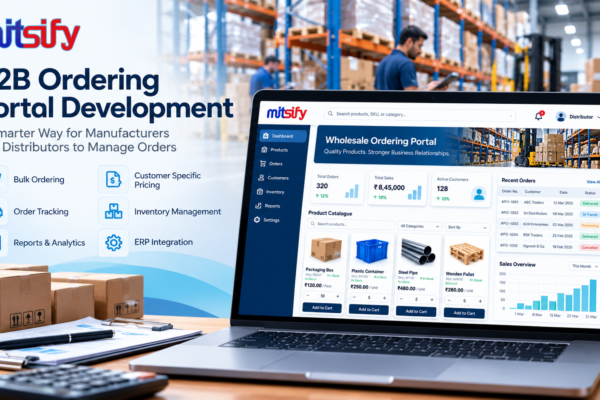
Some businesses need online payments, customer accounts, dashboards, inventory integration, booking systems, or automated workflows.
These requirements may call for an ecommerce website or a custom web application rather than a basic company profile website.
6. Do You Need All Three Platforms?
Not necessarily. Start with the channels that serve your customers and business objectives.
Option 1: Instagram + WhatsApp
This may be sufficient for a small business that sells through visual content and direct customer conversations.
It can be a practical starting point when the product range is small and the existing sales process works well.
Option 2: Website + WhatsApp
This can work well for service businesses, consultants, B2B suppliers, and professional firms.
The website presents detailed information, while WhatsApp gives customers a convenient way to ask questions or request further details.
Option 3: Website + Instagram + WhatsApp
For many growing businesses, this combination can provide a more complete customer journey.
Instagram helps people discover the business, the website explains the offering, and WhatsApp supports direct communication and follow-up.
The website can also include links to social profiles and a WhatsApp contact button.
Option 4: Website + Custom Web Application
Businesses with complex operational requirements may need a custom application for customer portals, order tracking, reporting, inventory, workflow automation, or integrations.
This is a different investment from a standard business website and should be considered when there is a clear operational or commercial need.
7. How Much Does Each Option Cost?
Costs vary depending on the tools used, the features required, and the amount of ongoing work involved.
| Option | Main costs to consider |
|---|---|
| Content creation, photography, time, and optional advertising | |
| WhatsApp Business | Staff time, messaging tools, and any applicable paid services |
| Business website | Development, domain, hosting, content, maintenance, and optional marketing |
| Ecommerce website | Website costs plus product management, checkout, payments, and order operations |
| Custom web application | Requirements analysis, development, integrations, security, hosting, and maintenance |
A free social media account is not necessarily cost-free to operate because creating content and responding to customers takes time.
Similarly, a website is not automatically a profitable investment. Its value depends on whether it helps achieve a meaningful business outcome.
Before spending money, define what success would look like—for example, more qualified enquiries, less repetitive work, improved product discovery, or a more organised sales process.
8. How to Choose the Right Option for Your Business
Ask yourself the following questions before deciding.
Question 1: How do customers currently find you?
If most customers come through Instagram, referrals, or local contacts, improving those channels may be a sensible starting point. If potential customers search Google for your services, a website may provide an additional opportunity to reach them.
Question 2: What information do customers need before purchasing?
If photographs and short conversations are enough, social platforms may work well. If customers need detailed service descriptions, specifications, case studies, or quotations, a website may help.
Question 3: Are you losing enquiries or spending too much time managing them?
If conversations are becoming difficult to organise, consider structured forms, enquiry tracking, or other suitable tools.
Question 4: What is your main business goal?
Choose the channel based on whether your priority is audience discovery, customer communication, online sales, lead generation, or operational efficiency.
Question 5: Can you measure the result?
Track relevant measures such as qualified enquiries, completed orders, booked appointments, response times, and customer acquisition costs. These help you decide whether your investment is worthwhile.
9. A Practical Example: A Small Manufacturing Business
Imagine a manufacturer that supplies industrial components to other businesses.
The company initially receives enquiries through referrals and WhatsApp. It shares product photographs and specifications manually whenever a potential buyer requests them.
As the company grows, it faces several challenges:
- Buyers repeatedly request the same product information.
- Sales staff spend time preparing similar responses.
- New customers have difficulty finding the company online.
- The company wants to receive enquiries from additional regions.
In this situation, a product catalogue website may be useful.
The manufacturer could organise products by category, provide specifications, publish company information, and add a quotation request form. WhatsApp could remain available for quick communication, while LinkedIn and other marketing channels could help attract relevant buyers.
The website would not replace the company’s existing sales process. It would support it by making information easier to find and enquiries easier to initiate.
The same approach can be adapted to other industries, depending on their actual needs.
Conclusion: Which Is Best for Your Business?
A website, Instagram, and WhatsApp each serve a different purpose.
Instagram can help attract attention and showcase products. WhatsApp makes direct customer communication convenient. A website can organise business information, support search visibility, and provide structured ways to generate enquiries or complete transactions.
You do not need to invest in every channel immediately.
Start with your customers, identify the limitations of your current process, and choose the tools that solve those problems. As your business grows, you can combine these channels to create a more effective online presence.
Looking to build a business website or custom web application?
Mitsify Web Development LLP helps businesses explore web solutions based on their requirements, from business websites to custom web applications and integrations.
Visit Mitsify or explore our custom web development services to learn more.
Frequently Asked Questions
1. Is a website better than Instagram for business?
Neither is universally better. Instagram is useful for visual content and audience engagement, while a website offers more control over information, page structure, and enquiry workflows. The right choice depends on your business goals.
2. Can I run a small business without a website?
Yes. Some businesses operate successfully using referrals, social media, messaging platforms, or local customers. A website becomes more valuable when the business needs search visibility, detailed information, structured enquiries, or additional functionality.
3. Is WhatsApp Business enough for a small business?
It may be enough for a business with a manageable number of enquiries and a straightforward sales process. Businesses with more complex catalogues, reporting, or enquiry management needs may benefit from additional tools.
4. Can Instagram and WhatsApp work together with a website?
Yes. Businesses can use Instagram for discovery, their website for detailed information, and WhatsApp for customer conversations. Links and contact buttons can connect these channels.
5. Does a website guarantee more customers?
No. A website alone does not guarantee leads, sales, or search rankings. Results depend on the offering, content, user experience, visibility, competition, and how enquiries are handled.
6. What type of website is best for a small business?
A simple business website may be sufficient for presenting services and contact details. Product catalogue websites, ecommerce stores, and custom web applications are more suitable when the business requires additional features or workflows.
7. How do I know if my business is ready for a website?
Consider whether you have a clear business objective, whether customers need information that is difficult to provide through current channels, and whether a website could improve discovery, enquiries, sales, or operational efficiency.