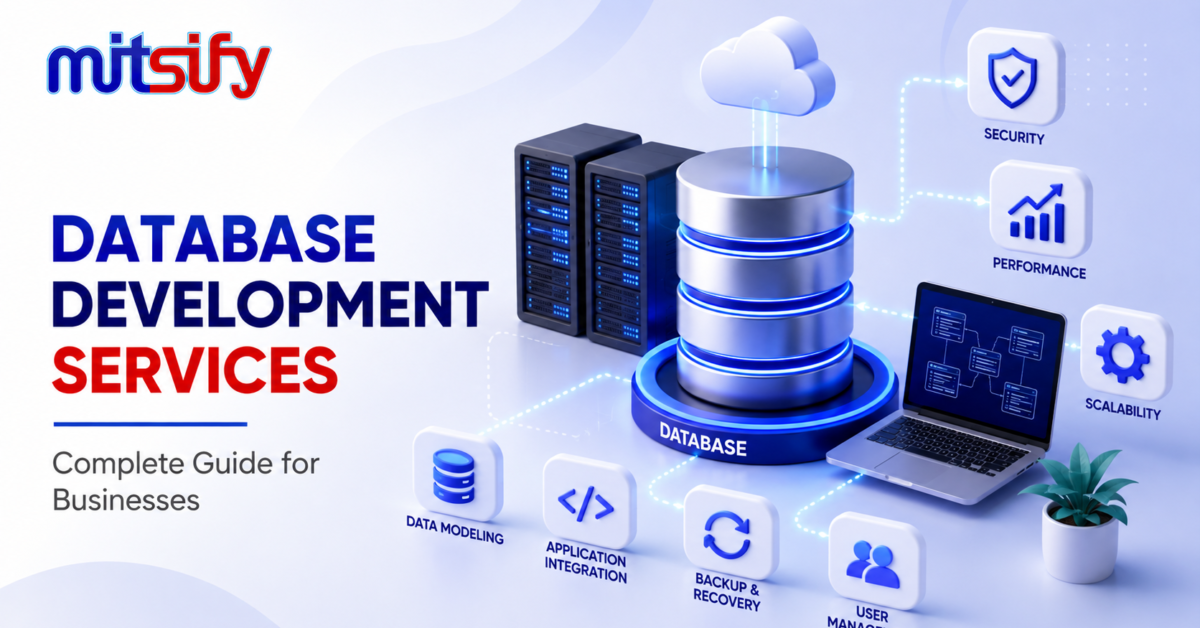
Database Development is an important part of modern software development. Websites, mobile applications, SaaS platforms, e-commerce systems, ERP applications, billing software, CRM systems, and other business applications rely on databases to store, organize, retrieve, and manage information.
A well-designed database helps applications manage business data efficiently while supporting security, performance, scalability, and reliable data access.
Whether you are building a new application or improving an existing software system, professional database development services can help create a structured and reliable data foundation for your application.
What Is Database Development?
Database Development is the process of designing, creating, implementing, testing, optimizing, and maintaining a database that supports an application or business system.
A database stores information in a structured way so that applications can create, update, search, and retrieve data when required.
For example, an e-commerce application may use a database to store:
- Customer information
- Product information
- Product prices
- Inventory data
- Orders
- Payments
- Shipping information
- Customer addresses
The database structure should be designed according to the application’s business requirements and expected usage.
Why Is Database Development Important?
Applications generate and process large amounts of data. Without a properly designed database, an application can experience slow performance, inconsistent data, difficult maintenance, and scalability challenges.
Professional database development can help businesses:
- Organize business data efficiently
- Improve application performance
- Support secure data access
- Reduce duplicate data
- Improve data consistency
- Support application scalability
- Enable efficient reporting
- Support integrations with other applications
- Improve data management
- Provide a reliable foundation for software applications
Database Design vs Database Development
| Database Design | Database Development |
|---|---|
| Defines database structure | Implements the database system |
| Defines tables and relationships | Creates tables, queries, procedures, and other database objects |
| Focuses on data organization | Focuses on implementation and functionality |
| Defines data models | Supports application integration |
| Plans data relationships | Includes testing and optimization |
Types of Database Development
Different applications require different database technologies. The appropriate database depends on data structure, application requirements, scalability, performance, and development architecture.
SQL Database Development
SQL databases store structured data using tables, rows, columns, relationships, and queries. They are widely used for business applications that require structured data and transactional consistency.
Popular SQL databases include:
- MySQL
- PostgreSQL
- Microsoft SQL Server
- Oracle Database
- MariaDB
NoSQL Database Development
NoSQL databases are designed for different data models and can be useful for applications that require flexible schemas, large-scale data handling, or specific access patterns.
Examples include:
- MongoDB
- Cassandra
- Redis
- Amazon DynamoDB
Cloud Database Development
Cloud databases can be hosted using cloud infrastructure and managed database services. They can support modern applications that require flexible infrastructure, availability, monitoring, and scalability.
Cloud database environments can be used with platforms such as AWS, Microsoft Azure, and Google Cloud.
Database Development Services
A complete database development project can include several stages, from database architecture and schema design to optimization, security, and maintenance.
1. Database Architecture
Database architecture defines how the database interacts with the application, backend services, APIs, users, and other systems.
2. Database Schema Design
Schema design defines tables, fields, relationships, constraints, indexes, and other database structures required by the application.
3. Database Development
The database is implemented using the selected database technology. This may include tables, queries, stored procedures, functions, views, indexes, and other database objects.
4. Database Integration
The database is connected with the application’s backend and APIs so that application users can securely create, retrieve, update, and manage data.
5. Database Migration
Database migration involves moving data from one database system, version, environment, or architecture to another while maintaining data integrity.
6. Database Optimization
Database optimization focuses on improving query performance, indexing, data access patterns, and overall database efficiency.
7. Database Security
Database security helps protect business data through appropriate authentication, authorization, encryption, access controls, backups, and monitoring.
8. Database Maintenance
Regular maintenance helps keep databases reliable and efficient as application usage and data volume grow.
Database Development Process
A structured database development process helps create a database that matches application requirements and future business needs.
Step 1: Requirement Analysis
The first step is to understand the application’s business requirements, data requirements, users, workflows, integrations, and expected data volume.
Step 2: Identify Data Entities
Important business entities are identified. For example, an inventory application may contain products, suppliers, purchases, sales, customers, payments, and stock transactions.
Step 3: Create the Data Model
A data model defines how different entities are organized and how they relate to each other.
Step 4: Design Database Schema
The database schema is created with tables, fields, primary keys, foreign keys, relationships, constraints, and indexes.
Step 5: Select Database Technology
The appropriate database technology is selected based on application requirements, data structure, performance, scalability, and infrastructure.
Step 6: Implement the Database
Database objects and required queries are implemented according to the approved design.
Step 7: Connect Database with Application
The backend application connects with the database through appropriate database drivers, ORM tools, APIs, or other integration methods.
Step 8: Test the Database
The database is tested for functionality, data integrity, performance, security, and expected application workflows.
Step 9: Optimize Performance
Queries, indexes, database structure, and data access patterns are reviewed and optimized where necessary.
Step 10: Deploy and Maintain
The database is deployed to the required environment and monitored regularly to maintain reliability, security, and performance.
Database Development for SaaS Applications
SaaS applications typically manage multiple users, organizations, subscriptions, permissions, transactions, reports, and application settings. Therefore, database architecture is an important part of SaaS development.
A SaaS database may need to manage:
- User accounts
- Organizations
- User roles
- Permissions
- Subscriptions
- Billing information
- Application data
- Reports
- Notifications
- Audit records
Database architecture should be planned carefully to support the product’s current requirements as well as future growth.
Learn more about SaaS Development: Complete Guide.
Database Development for Mobile Applications
Mobile applications often communicate with backend services and databases through APIs. The database stores application data while the backend provides controlled access to the mobile application.
Common mobile application data includes:
- User profiles
- Authentication data
- Application settings
- Products and services
- Orders
- Transactions
- Notifications
- Location-related data
For complete mobile application development, explore Mobile App Development Services.
Database Development for Web Applications
Web applications commonly use databases to manage user accounts, content, transactions, products, orders, reports, and other business information.
A typical web application architecture may include:
- Frontend application
- Backend application
- API layer
- Database
- Authentication system
- Cloud infrastructure
Database performance can directly affect the responsiveness of web applications, especially when the application handles a large number of users or records.
Read our Web Application Development: Complete Guide.
Database Development for Business Software
Business applications depend heavily on accurate and well-structured data. Billing, inventory, CRM, ERP, accounting, pharmacy, jewellery, and retail applications can require complex database structures.
For example, a billing application may need to manage:
- Customers
- Products
- Sales
- Sales returns
- Purchases
- Purchase returns
- Payments
- Inventory
- Suppliers
- Users
- Branches
- Reports
A properly designed database helps these modules share data consistently while supporting application workflows and reporting requirements.
Database Security
Business databases may contain important operational and customer information. Database security should therefore be considered from the early stages of application development.
Important database security practices include:
- Strong authentication
- Role-based access control
- Least-privilege database access
- Secure application connections
- Encryption where appropriate
- Regular backups
- Monitoring and logging
- Secure password handling
- Protection against SQL injection
- Controlled database permissions
Database Performance Optimization
As application data grows, database performance can become an important consideration. Database optimization helps applications retrieve and process information efficiently.
Common optimization techniques include:
- Creating appropriate indexes
- Optimizing database queries
- Reviewing slow queries
- Improving database schema design
- Reducing unnecessary data retrieval
- Using appropriate pagination
- Optimizing relationships and joins
- Monitoring database performance
- Using caching where appropriate
Database Backup and Recovery
Database backups are an important part of business continuity and data protection. A backup strategy should consider how frequently data changes and how quickly the business needs to recover from a failure.
Backup planning may include:
- Automated backups
- Backup retention policies
- Multiple backup locations
- Recovery testing
- Database restoration procedures
- Disaster recovery planning
Database Migration Services
Businesses may need database migration when changing software platforms, upgrading database technologies, moving to cloud infrastructure, or replacing legacy applications.
Database migration may involve:
- Data extraction
- Data transformation
- Data validation
- Schema conversion
- Data import
- Application integration
- Testing
- Production migration
A carefully planned migration process helps reduce data loss and application downtime.
Database Development and API Integration
Modern applications often use APIs to communicate between frontend applications, backend services, databases, and external systems.
A typical application flow can be:
User Interface → API → Backend → Database → Backend → API → User Interface
This architecture allows applications to control database access through backend services instead of exposing the database directly to users.
Learn more about API Development & Integration.
Database Development and Cloud Computing
Cloud infrastructure provides businesses with different options for hosting applications and databases. Depending on requirements, organizations can use managed database services, cloud servers, automated backups, monitoring, and scalable infrastructure.
Cloud database architecture can be useful for SaaS applications, mobile applications, web applications, and distributed business systems.
Read our Cloud-Based Software Development: Complete Guide.
Database Development Technology Stack
The technology stack depends on the application requirements and development architecture.
- Relational Databases: MySQL, PostgreSQL, SQL Server, MariaDB, Oracle
- NoSQL Databases: MongoDB, Redis, Cassandra, DynamoDB
- Backend Technologies: Node.js, PHP, Python, Java, .NET
- ORM Technologies: Entity Framework, Sequelize, Hibernate, Prisma, Laravel Eloquent
- Cloud Platforms: AWS, Microsoft Azure, Google Cloud
- Database Tools: MySQL Workbench, pgAdmin, SQL Server Management Studio and other database administration tools
Database Development for E-Commerce
E-commerce platforms manage large amounts of product, customer, order, inventory, payment, and shipping information.
A typical e-commerce database may contain:
- Customers
- Products
- Categories
- Product variations
- Inventory
- Shopping carts
- Orders
- Payments
- Shipping
- Discounts
- Reviews
Good database design helps e-commerce applications manage these relationships efficiently.
Database Development for CRM and ERP Systems
CRM and ERP systems typically contain many interconnected business modules. Database architecture is therefore critical for maintaining consistent information across departments and workflows.
CRM databases may manage:
- Leads
- Customers
- Contacts
- Sales opportunities
- Activities
- Follow-ups
- Reports
ERP databases may manage:
- Inventory
- Purchasing
- Sales
- Finance
- Suppliers
- Employees
- Reports
Database Development for Custom Software
Custom software applications often have unique workflows and business rules. The database should therefore be designed according to the organization’s actual requirements instead of forcing the business into a generic data structure.
Custom database development can support applications such as:
- Business management software
- Inventory systems
- Billing applications
- CRM systems
- ERP platforms
- Healthcare applications
- Retail applications
- Jewellery software
- Logistics systems
- Financial applications
Learn more about Custom Software Development: Complete Guide.
How Much Does Database Development Cost?
The cost of database development depends on the size and complexity of the application, database architecture, number of entities, integrations, security requirements, performance requirements, and development environment.
Factors that can influence database development cost include:
- Database size
- Number of tables
- Data relationships
- Number of application modules
- Database technology
- API requirements
- Migration requirements
- Security requirements
- Performance requirements
- Cloud infrastructure
- Backup and recovery requirements
- Maintenance requirements
How to Choose a Database Development Company
Choosing an experienced database development company can help businesses build a reliable data architecture that supports their application requirements.
Consider the following factors:
- Database development experience
- Knowledge of SQL and NoSQL databases
- Backend development expertise
- API integration experience
- Cloud database experience
- Database security practices
- Performance optimization experience
- Migration experience
- Backup and recovery planning
- Understanding of business requirements
- Post-development maintenance and support
Database Development Best Practices
- Understand business requirements before designing the database
- Use a clear and consistent naming convention
- Define appropriate relationships between entities
- Use indexes where they provide performance benefits
- Validate data before storing it
- Use appropriate access controls
- Keep sensitive information protected
- Monitor database performance
- Maintain regular backups
- Test database recovery procedures
- Plan for future scalability
- Document important database structures
Frequently Asked Questions About Database Development
What is database development?
Database development is the process of designing, creating, implementing, testing, optimizing, and maintaining databases used by software applications and business systems.
What is database design?
Database design is the process of planning how data will be organized, stored, related, and accessed within a database.
What is the difference between SQL and NoSQL databases?
SQL databases generally use structured tables and relationships, while NoSQL databases support different data models and can provide more flexible data structures for certain application requirements.
Which database is best for a business application?
There is no single database that is best for every application. The appropriate database depends on data structure, application requirements, transaction needs, performance, scalability, integrations, and development architecture.
Is database security important?
Yes. Database security is important for protecting business information and controlling who or what can access, modify, or manage stored data.
What is database optimization?
Database optimization involves improving database queries, indexes, schema structures, and data access patterns to improve application performance.
Can an existing database be migrated to the cloud?
Yes. Existing databases can often be migrated to cloud infrastructure after evaluating compatibility, data size, application dependencies, security requirements, downtime, and recovery planning.
Is database development required for SaaS applications?
Yes. SaaS applications typically require databases to manage users, organizations, application data, subscriptions, permissions, transactions, and other information.
Can database development be integrated with mobile and web applications?
Yes. Mobile and web applications commonly communicate with databases through backend services and APIs. This provides a controlled way to access and manage application data.
Conclusion
Database Development provides the data foundation required by modern websites, mobile applications, SaaS platforms, and business software. A well-designed database can help applications manage information efficiently while supporting security, performance, scalability, and reliable data access.
From database architecture and schema design to API integration, optimization, migration, security, backup, and maintenance, every stage should be planned according to the application’s requirements.
If your business is planning a new SaaS product, mobile application, web application, or custom software solution, investing in a structured database architecture can provide a strong foundation for future growth.
Related Articles
- SaaS Development: Complete Guide
- MVP Development: Complete Guide
- UI/UX Design: Complete Guide for Businesses
- API Development & Integration: Complete Guide
- Custom Software Development: Complete Guide
- Cloud-Based Software Development: Complete Guide
- Mobile App Development: Complete Guide for Businesses
- Web Application Development: Complete Guide
Explore Mitsify Software Development Services
Mitsify helps businesses build software solutions including SaaS applications, mobile applications, web applications, APIs, databases, and custom business software.